Ask most call center managers how their operation is performing financially, and they'll quote you cost per agent, or cost per hour, or total monthly spend against total calls handled. All three numbers can look healthy on a report — and still be hiding a business that's losing money on every single shift.
The problem isn't that these numbers are wrong. It's that they answer the wrong question. They tell you what you're spending. They don't tell you what you're spending it to get.
Here's the metric that actually predicts ROI, why almost nobody tracks it correctly, and how to fix it without hiring a data analyst.
The Metric Everyone Tracks: Cost Per Agent
Cost per agent is easy to calculate, which is exactly why it's everywhere. Salary, plus infrastructure, plus software licensing, divided by number of agents. It tells you what a seat costs you per month.
The trap: cost per agent treats every agent-hour as equally valuable, when it clearly isn't. An agent who completes 40 productive calls a day and an agent who completes 15 cost you the exact same amount on this metric — but they are not delivering the same return.
If your entire cost tracking stops at "cost per agent," you're optimizing for headcount efficiency, not business outcomes. Those are not the same thing.
The Metric That Actually Matters: Cost Per Successful Call
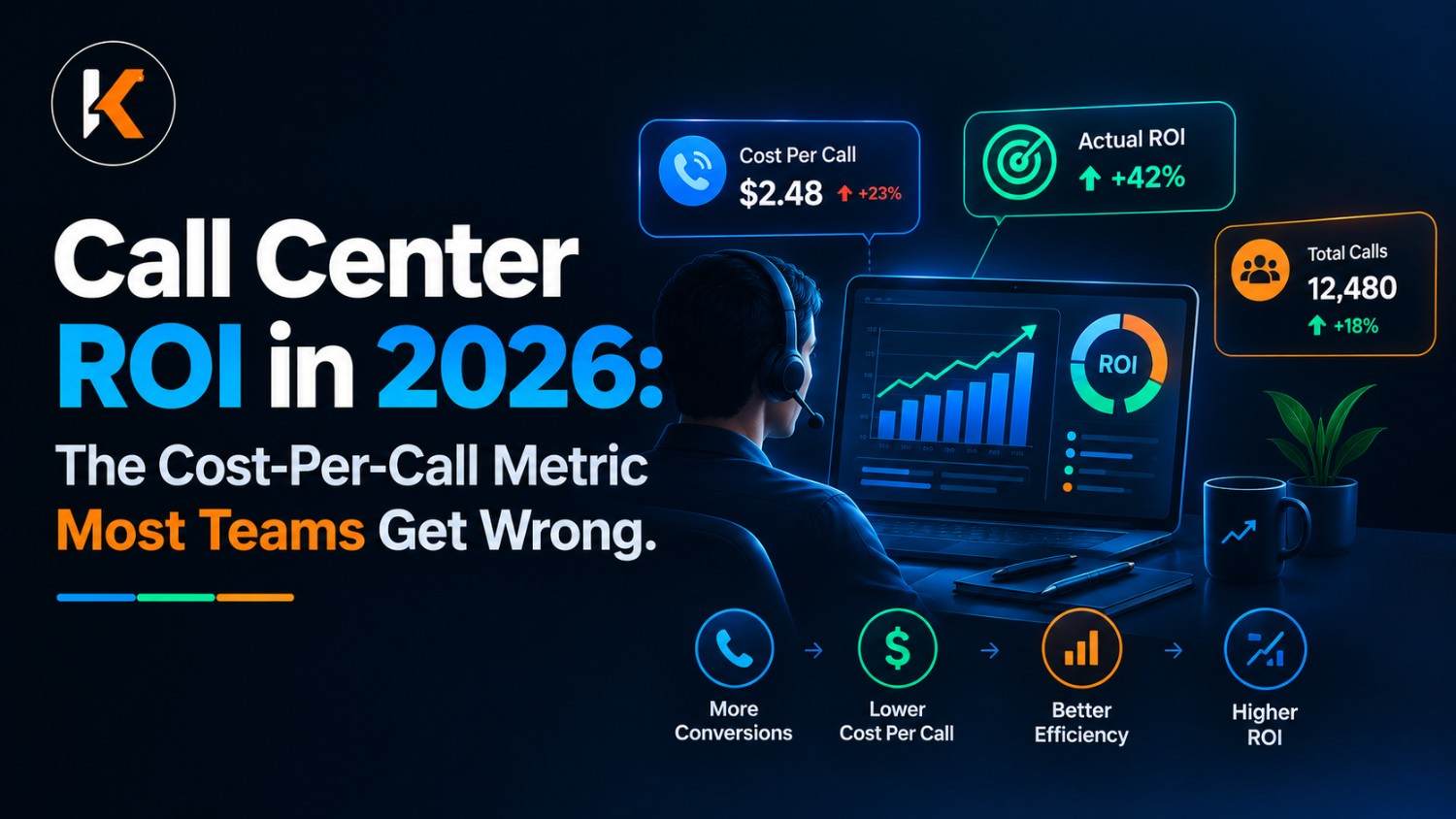
Cost per successful call = Total operating cost ÷ Number of calls that achieved their purpose (a sale closed, a payment collected, a resolution delivered, a qualified lead booked — whatever "successful" means for your specific campaign).
This single change in what you measure exposes problems that cost-per-agent hides completely:
- Dead time between calls — an agent manually dialing, waiting for rings, or navigating a clunky CRM between calls isn't costing you more per agent, but it's costing you significantly more per successful call, because fewer of those calls happen per hour.
- Bad lead lists — calling numbers that are disconnected, wrong, or already converted doesn't show up in cost per agent at all. It shows up immediately in cost per successful call, because the denominator (successful outcomes) drops while the numerator (total cost) stays the same.
- High agent attrition — retraining costs, ramp-up time for new hires, and the productivity dip during onboarding are all buried inside "cost per agent" as a rounding error. They're a visible spike in cost per successful call, because new agents convert at a lower rate while costing the same to employ.
A Real Example: Same Team, Two Very Different ROI Pictures
Consider two call centers, both running 30 agents at a fully loaded cost of ₹35,000 per agent per month — so both show an identical ₹10.5 lakh monthly cost, and both look the same on a "cost per agent" report.
Call Center A uses manual dialing, an unfiltered lead list, and has 22% agent attrition per quarter. Agents complete an average of 45 dials per day but only 6 successful outcomes, because most of the day is spent on disconnected numbers, no-answers, and manual dial delays.
Call Center B uses a predictive dialer with automated list-cleaning, and has 9% attrition thanks to less repetitive manual work. Agents complete 90 dials per day (the dialer handles the waiting and filtering) with 14 successful outcomes.
| Metric | Call Center A | Call Center B |
|---|---|---|
| Monthly cost | ₹10.5 lakh | ₹10.5 lakh |
| Successful outcomes/agent/day | 6 | 14 |
| Total monthly successful outcomes (22 working days) | 3,960 | 9,240 |
| Cost per successful call | ₹265 | ₹114 |
Both centers show identical cost-per-agent numbers. One of them is spending more than double to get each successful outcome. If you were only tracking cost per agent, you'd never see this gap — and you'd never know which lever to pull to close it.
Why Cost Per Successful Call Changes What You Optimize For
Once cost per successful call becomes your primary metric, the priorities shift in a way that actually maps to ROI:
Reducing idle time between calls stops being a "nice to have" efficiency tweak and becomes a direct cost lever — because every minute an agent isn't on a productive call is diluting your denominator.
Lead list quality becomes as important as agent headcount. A cleaner list with fewer dead numbers means more of every dialing hour goes toward calls that can actually convert.
Agent retention becomes a financial priority, not just an HR one — because the ramp-up period for every new hire is a visible tax on your cost-per-successful-call number, not an invisible one.
Call routing and skill-matching matter more, because sending the right call to the right agent raises the success rate without raising the cost.
How to Start Tracking It This Month
You don't need new software to start — most CRMs and dialer platforms already log the raw numbers you need.
- Define "successful" precisely for each campaign — a sale, a scheduled callback, a resolved ticket, a qualified lead. Ambiguous definitions make the metric useless, so get specific before you calculate anything.
- Pull total operating cost for the period — salaries, software, telephony charges, and any campaign-specific costs (leads purchased, incentives paid).
- Pull total successful outcomes for the same period, broken down by campaign if you run more than one.
- Divide cost by outcomes. That's your baseline. Track it monthly, not just quarterly — the variance from agent attrition or bad lead batches shows up faster than you'd expect.
- Compare cost per successful call against cost per agent side by side. If the two numbers tell different stories, the gap itself is your diagnostic — it tells you whether your problem is headcount cost or conversion efficiency.
Cost per agent tells you what your team costs. Cost per successful call tells you what your results cost — and results are what actually show up in revenue. A call center can look financially disciplined on the first metric and be quietly overspending by 2x on the second, simply because nobody's measuring the number that matters.
The fix usually isn't a bigger budget. It's closing the gap between dials and outcomes — through better dialing technology, cleaner lead data, and lower attrition — so every rupee spent on agent time has a higher chance of converting into a successful call.
Want to see what your actual cost per successful call looks like — and where a predictive dialer would close the gap ? Book a free demo with KRUDRA-CX and we'll run the numbers against your current setup.