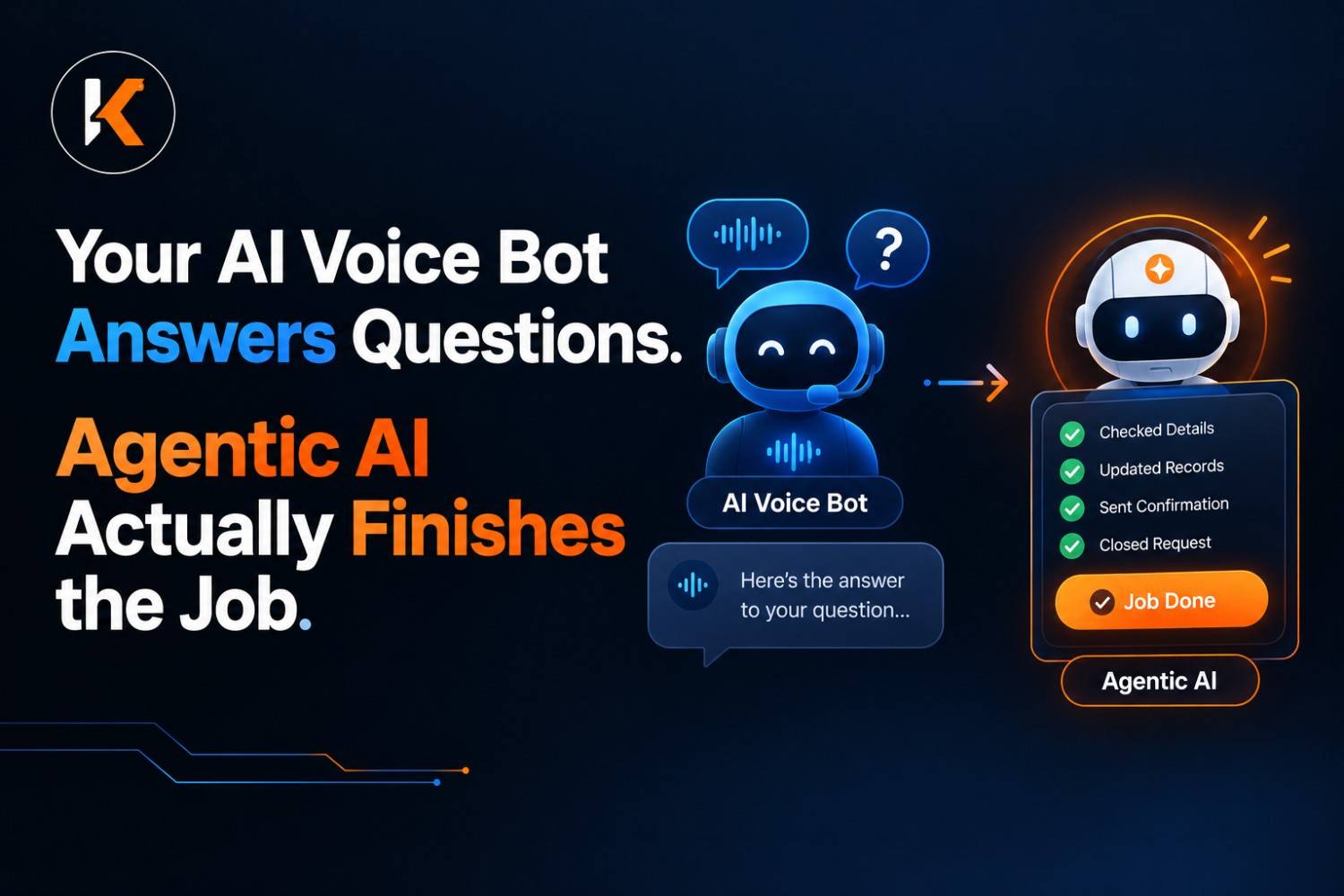
A customer calls to change their delivery address, cancel one item from an order, and ask about a refund timeline. Traditional voice bots can answer the third part — refund policy is a lookup. The first two need someone to actually go into the order system and make changes. That's usually where the bot hands off to a human, and the customer waits in queue for something that should have taken thirty seconds.
Agentic AI is built to close exactly that gap. It doesn't just answer questions — it takes the actions a human agent would normally take, across multiple systems, in a single interaction. The distinction matters more than it sounds: conversational AI understands what the customer wants; agentic AI actually goes and does it.
What "agentic" means in a contact center context
The word gets used loosely, so it's worth being precise. An agentic AI system has three capabilities a standard voice bot doesn't:
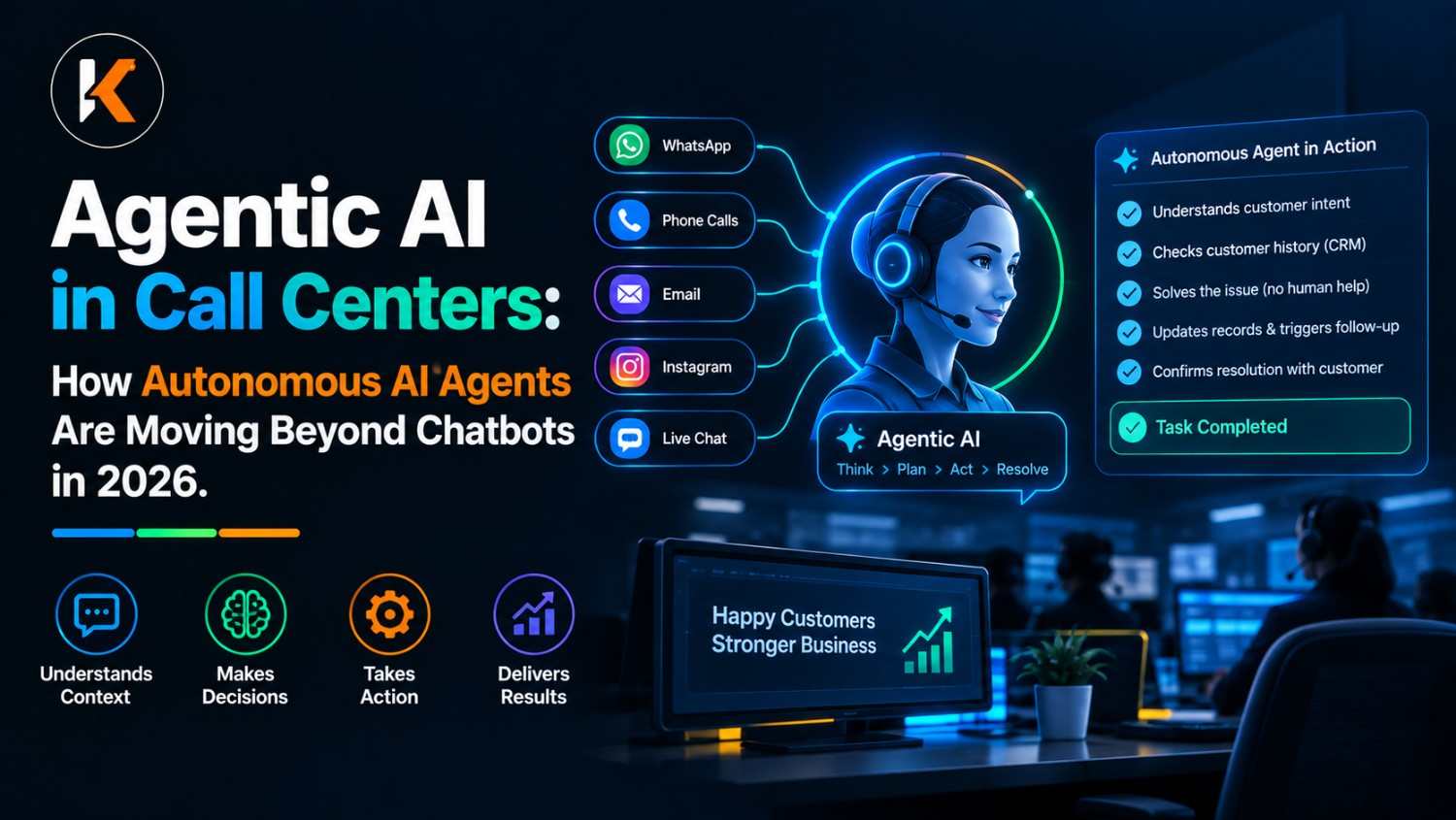
Multi-step task execution — it can complete a sequence of actions across systems (check order status, initiate a return, update the CRM, send confirmation) without a human triggering each step manually.
Tool and system access — it's connected to the actual backend systems — CRM, order management, billing, ticketing — with permission to read and write data, not just retrieve information to display.
Autonomous decision-making within defined limits — it decides which action to take based on the situation, within boundaries you set, rather than following a single fixed script.
The "within defined limits" part is the entire point. Agentic AI isn't given free rein over your systems — it operates inside guardrails: a refund up to a certain amount, an address change with certain verification, but anything outside those bounds routes to a human automatically.
A concrete example
Customer calls about a damaged product. A standard voice bot would answer "here's our return policy" and route to an agent to actually process anything. An agentic system verifies the order, confirms it qualifies for a no-questions return under policy, initiates the return in the order system, generates a return label, and confirms the refund timeline — all inside one call, with no human needed unless the order falls outside standard policy (high value, past return window, repeat return pattern flagged for review).
That last part is what makes this safe rather than reckless: exceptions still go to a person. The system isn't guessing on edge cases — it's handling the high-volume, low-ambiguity cases end-to-end and routing everything else out.
Why this is the trend right now, not two years ago
Two things had to mature before this became viable. First, the underlying AI models got reliable enough at following multi-step instructions and correctly deciding when they're uncertain — earlier voice bots that tried this failed because they'd confidently take the wrong action instead of recognizing they were out of their depth. Second, the integration layer connecting AI systems to backend business tools got standardized enough that "AI can safely read and write to your CRM" stopped being a custom engineering project for every deployment.
Together, that's what pushed agentic AI from an experimental pilot to something Sales Directors and Call Center Managers are actively evaluating in 2026.
How this builds on what you're already running
This isn't a replacement for your conversational voice bot or real-time agent assist — it's the next layer. The voice bot handles natural language understanding. Agentic AI adds the ability to act on what it understood. If you've already deployed voice bots for query handling, the natural next step is scoping which of those queries also involve a backend action your bot currently just describes instead of completing.
Same logic applies to your workforce management investment — every interaction agentic AI fully resolves is one that never needed to sit in a human queue at all, which changes the actual staffing math, not just the average handle time.
Where this needs to stay careful
This is also where a lot of the hype outpaces good deployment practice. A few things matter more than the marketing suggests:
Scope discipline — start with narrow, well-defined, reversible actions (address updates, standard-policy refunds, appointment rescheduling), not high-stakes or irreversible ones. The value comes from volume on simple tasks, not from trying to automate everything on day one.
Audit trail — every action the system takes needs to be logged and reviewable, the same way you'd expect from a human agent's actions. If something goes wrong, you need to see exactly what the AI did and why.
Escalation clarity — the system needs to know what it doesn't know. The failure mode to actively test for isn't the AI refusing to help — it's the AI confidently taking an action it shouldn't have, in a case that looked routine but wasn't.
Customer disclosure — depending on your regulatory environment, customers may need to know they're interacting with an autonomous system taking actions on their account, not just answering questions.
What to check before evaluating a vendor
Permission granularity: can you actually limit what the system can do — dollar thresholds, specific action types, specific customer segments — or is it all-or-nothing access to your systems?
Fallback behavior: what happens when the system is uncertain? The right answer is a clean handoff to a human with full context, not a guess dressed up as confidence.
Integration reality: ask for a live demo against your actual CRM and order systems, not a sandboxed example — this is where agentic AI projects most often stall, because backend integration complexity is usually underestimated.
The honest tradeoff
Agentic AI genuinely reduces handle time and human workload on the categories of requests it's scoped for — but scoping it too broadly, too early, is where deployments go wrong. The businesses getting real value from this in 2026 started with a narrow set of safe, reversible, high-volume actions, proved it out, and expanded scope gradually. The ones chasing the full "AI handles everything" pitch from day one are the ones dealing with cleanup.
Ready to see which of your calls could actually be resolved end-to-end?
KRUDRA-CX helps Indian contact centers move from AI that just talks to AI that safely takes action — scoped to what your business actually needs automated first.
Book Free Demo → krudracx.com/book-for-demo
Talk to Sales → krudracx.com/contact