The Customer Journey Is Broken — Here's Where Businesses Lose Money (And How to Fix Every Stage)
Most businesses believe they have a lead generation problem. They pour money into ads, SEO, cold outreach, and influencer partnerships — and still watch revenue stagnate. The real culprit is almost never the top of the funnel. It's what happens after a potential customer first discovers you.
The customer journey — the path from first awareness to long-term loyalty — is leaking at every single stage. Silently. Expensively. And most business owners have no idea it's happening because they're only measuring the beginning and the end, never the middle.
This guide breaks down every stage where businesses lose customers and revenue, what the data says about each leak, and exactly what the top-performing companies do differently.
The Comfortable Lie Most Businesses Tell Themselves
Here's the funnel most founders and sales managers picture when they close their eyes: someone sees your ad or finds your website, they fill out a form, your team calls them, the deal closes, the customer stays. Clean. Linear. Predictable.
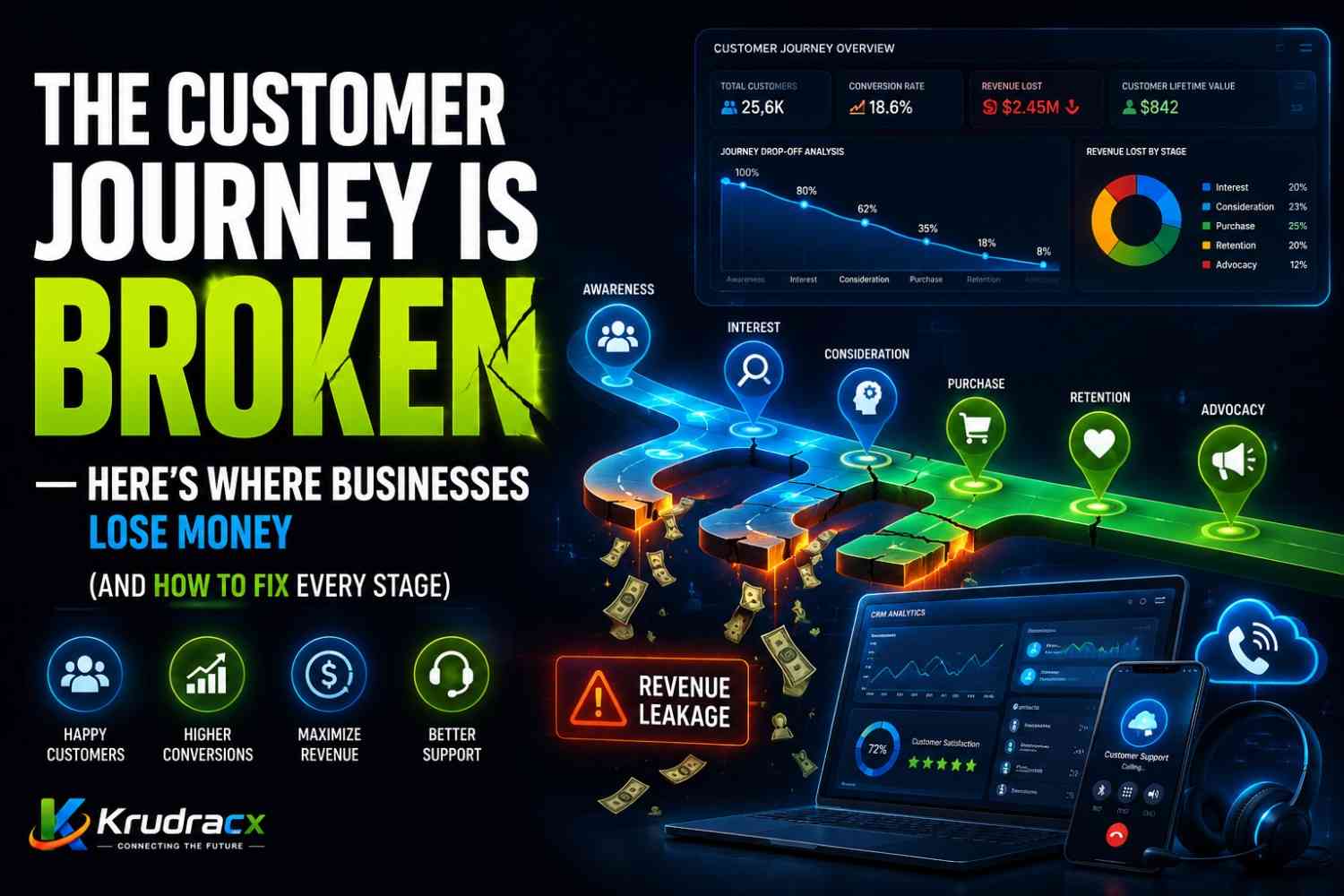
Here's what the data actually shows. Of every 100 people who discover your business, roughly 85 engage enough to qualify as prospects. Of those 85, only about 52 actually submit a lead form or reach out. Of those 52, only 31 get contacted within any reasonable timeframe. Of those 31, maybe 18 convert to paying customers. And of those 18, only 9 are still with you a year later.
You started with 100. You kept 9.
That is not a lead generation problem. That is a customer journey problem — and every single drop-off point represents money that was already in your ecosystem, money you had already paid to attract, slipping away because the systems, the people, or the process between stages failed.
Stage 1: Awareness — You Exist, But Do They Trust What They Find?
The awareness stage feels like the most controllable. You run ads, you post content, you show up in search results. But showing up and being trusted are two entirely different things, and most businesses confuse activity with effectiveness at this stage.
The most common awareness failures are not about reach — they are about credibility. A potential customer finds you through an ad, clicks through to your website, and within eight seconds decides whether to stay or leave. That decision is driven almost entirely by trust signals: do you look legitimate, do other people vouch for you, does your message match what they were looking for?
When businesses have inconsistent messaging across channels — a different value proposition on Instagram than on the website, a LinkedIn page that hasn't been updated in six months, a Google Business profile with no reviews — it sends a subconscious signal that the company is either small, disorganised, or not serious. Any of those perceptions kills conversion before the journey even begins.
Load speed is another silent killer at awareness. Research consistently shows that more than half of mobile users abandon a page that takes longer than three seconds to load. For businesses that have invested in ads but neglected their website's technical performance, they are literally paying to send people to a wall.
The fix at awareness is not more traffic. It's a consistency audit — making sure that every surface where your business appears tells the same story with the same confidence, and that the first click experience is fast, credible, and immediately relevant.
Stage 2: Lead Capture — The Moment Most Businesses Fumble First Contact
A prospect who has decided to reach out to you is one of the most valuable assets in your business. They have already done the hard psychological work of moving from passive observer to active interest. What you do in the next sixty seconds determines whether that interest converts to a conversation or evaporates.
Most businesses make lead capture harder than it needs to be, and the damage is significant. Every additional field in a contact form reduces completion rates. Studies on B2B forms show that going from three fields to seven drops conversion by nearly 40%. Yet the average business contact form asks for company name, full name, email, phone number, website, industry, company size, monthly budget, and how the person heard about them — before a single conversation has happened.
The psychology here is straightforward. At the point of first reach-out, a prospect does not yet trust you enough to give you their full business profile. They want to know if you can help them. You want to know if they are worth your time. Neither party should front-load the relationship with a data extraction exercise.
The businesses that convert best at lead capture use what is called progressive profiling — they ask for the minimum required to have a useful first conversation. Name, phone number, and one qualifying question. Everything else gets gathered across the relationship as trust builds.
The second failure at lead capture is the absence of instant acknowledgment. When someone submits a form and receives nothing — no email, no SMS, no automated confirmation — the silence communicates that their enquiry may not have been received, or worse, that the business does not care. Prospects who submit and hear nothing within five minutes have almost universally moved on to the next option before your team even picks up the notification.
Stage 3: First Contact — The Five-Minute Window That Most Businesses Miss
This is where the research becomes genuinely alarming for most business owners. Studies on lead response time, including widely cited research by Harvard Business Review and InsideSales, consistently find that the odds of qualifying a lead drop by ten times if the first contact attempt happens more than five minutes after enquiry submission. Ten times. Not ten percent — ten times.
Yet the average business response time across industries sits somewhere between five and forty-seven hours.
The reason this gap is so devastating is that intent is a perishable resource. When someone reaches out to you, they are in a moment of active motivation. They have a problem that feels urgent enough to act on. That feeling has a half-life of minutes, not hours. By the time your team calls them back the next business morning, the urgency has faded, they have contacted two competitors, and they have probably received a call back from at least one of them already.
Speed of first contact is the single highest-leverage change most businesses can make to their revenue without spending anything on additional marketing. It requires process change, not budget.
The practical fix involves two components working together. First, an automated immediate response that confirms receipt, sets expectations, and delivers something of value — a relevant case study, a short video, a useful piece of content related to what they enquired about. This keeps them engaged while a human is being routed to call them. Second, an internal SLA that holds someone accountable for making first contact within sixty seconds during business hours, with a clear escalation protocol when that window is missed.
The companies that consistently win on first contact are not necessarily the best at their service. They are the fastest. In most markets, being first to respond with confidence is sufficient to win the relationship.
Stage 4: Qualification — Where Sales Effort Goes to Die
Once first contact is made, the next critical failure point is qualification — or more accurately, the absence of it. Qualification is the process of determining whether a prospect has the budget, authority, need, and timeline to actually become a customer. Without a structured qualification framework, sales teams spend their time equally across prospects who will never buy and prospects who are ready to sign today.
The cost of this is enormous and almost never measured. When you calculate how much of your sales team's time is spent on unqualified conversations — demos given to people who have no decision-making authority, proposals written for companies whose budget is one tenth of your minimum engagement, follow-up sequences sent to people who were never going to buy — the number is typically between 40 and 70 percent of total sales effort.
The qualification frameworks that work — BANT (Budget, Authority, Need, Timeline), MEDDIC (Metrics, Economic Buyer, Decision Criteria, Decision Process, Identify Pain, Champion) — are not complicated. They are simply a set of questions that every sales conversation must answer before a prospect moves to the next stage. The discipline is not in knowing the framework. It's in refusing to advance opportunities that cannot answer the questions.
The most common qualification mistake is asking these questions too late. By the time a business has given a demo, prepared a proposal, and engaged in three follow-up conversations, there is emotional investment in the relationship that makes it psychologically difficult to disqualify the prospect. The qualification conversation needs to happen at the second touchpoint, not the fifth.
Stage 5: Follow-Up — The Revenue That Walks Out the Door Because No One Called Back
Research on B2B sales cycles consistently finds that 80 percent of sales require five or more touchpoints before closing. It also finds that 44 percent of sales reps give up after one follow-up attempt. This single gap — the distance between what it takes to close and how much effort most teams actually apply — is responsible for an extraordinary volume of lost revenue that businesses never even see because the prospect simply goes quiet and the rep marks the lead as cold.
The follow-up failure is partly a process problem and partly a psychology problem. The process problem is that most businesses have no defined follow-up sequence — reps are left to remember on their own who to call and when, which means the most persistent prospects get attention and the quieter ones get forgotten. The psychology problem is that many reps interpret silence as rejection, when the data shows that silence usually means busy, not uninterested.
The follow-up sequences that convert best are structured around value delivery, not persistence for its own sake. Each touchpoint gives the prospect something useful — a relevant insight, a case study from a similar company, an industry report, a short video answer to a question they raised in the last conversation. The implicit message is that the relationship has value even if the sale never happens. This changes the dynamic from "are you ready to buy yet" to "here is someone who actually understands my situation."
A four-week structured sequence typically looks like this: immediate post-enquiry value drop within the first hour, a soft check-in at day three that asks one specific question rather than making a pitch, a social proof nudge at day seven featuring a result from a comparable customer, and a respectful final close at day fourteen that explicitly gives the prospect permission to say no while leaving the door permanently open. This sequence, when executed consistently, recovers a significant portion of leads that would otherwise be written off as lost.
Stage 6: Customer Experience — Where Trust Is Either Built or Destroyed
Conversion is not the finish line. It is the beginning of the relationship that actually determines your business's long-term revenue. The customer experience stage — everything that happens after the first payment — is where most businesses reveal whether their operation matches their marketing.
The customer experience failures that kill retention most reliably are not catastrophic service failures. They are accumulated small disappointments: hold times that stretch past ten minutes, having to repeat the same problem to three different agents, discovering an issue with your own account before anyone from the company notified you, feeling like a ticket number rather than a person.
Research on customer experience consistently shows that one bad service interaction can override the goodwill built by dozens of positive ones. It also shows that customers who have a problem handled excellently are often more loyal than customers who never experienced a problem at all — because the recovery demonstrates that the company genuinely cares.
The metric that predicts retention most reliably at this stage is First Contact Resolution — whether the customer's issue was fully resolved in a single interaction. Companies with high First Contact Resolution rates see retention rates 31 percent higher than those that require multiple interactions to close a single issue. The investment required to improve FCR — better agent training, more comprehensive knowledge bases, clearer escalation paths, more agent authority to resolve issues without manager approval — pays back many times over in reduced churn.
Stage 7: Retention — The Profit That Most Businesses Leave on the Table
The economics of customer retention are so well established that they should be foundational to every business decision, yet most organisations allocate their energy almost entirely to acquisition. The data is unambiguous: acquiring a new customer costs five times more than retaining an existing one. A five percent improvement in retention rates increases profits by anywhere from 25 to 95 percent depending on the industry. Existing customers are 50 percent more likely to try new products and spend 31 percent more than new customers.
The retention failures that are most common and most avoidable share a common pattern: the business treats the sale as the end of active effort rather than the beginning of it. Post-sale onboarding is minimal or absent. The customer is expected to figure out how to get value from the product or service on their own. The only time the business reaches out proactively is when there is an upsell opportunity, not when there is a risk of disengagement.
Customers who do not fully activate within the first week of engagement churn at dramatically higher rates within the first three months. The critical window for retention is immediately post-sale — which is precisely when most businesses have already moved their attention to the next prospect.
The retention strategies that work reliably are not complicated. Structured onboarding that walks new customers through the specific steps required to get value quickly. Regular proactive check-ins that ask about experience rather than upsell. Quarterly business reviews for higher-value accounts that demonstrate the impact being delivered in data. Predictive churn monitoring that flags accounts showing early warning signals — reduced login frequency, declining usage, unresolved support tickets — so the customer success team can intervene before the cancellation decision is made.
The Revenue Leakage Map: What It All Costs
When you add up the losses across all seven stages, the picture for a typical business is sobering. Of every hundred rupees of potential revenue that enters your ecosystem at the awareness stage, roughly twelve rupees leak at awareness through poor trust signals and slow websites. Thirty-five rupees leak at lead capture through friction and silence. Twenty rupees leak at first contact through slow response. Ten rupees leak at qualification through wasted sales effort. Eight rupees leak through inadequate follow-up. Nine rupees leak through poor customer experience. Six rupees leak through preventable churn.
Run those numbers and the uncomfortable conclusion is that most businesses are capturing somewhere between ten and twenty percent of the revenue that their marketing investment makes available to them. The other eighty percent is not being lost to competitors with better products — it is being lost to better processes, better systems, and better follow-through.
How Top-Performing Companies Fix the Journey
The businesses that consistently outperform their markets on revenue growth are not necessarily doing something categorically different at the product level. What separates them is operational excellence across the customer journey — every stage has an owner, every stage has metrics, and every stage has a recovery protocol when performance falls below threshold.
The specific practices that show up consistently across high-performing organisations are worth naming directly. Sub-sixty-second first response times, enabled by a combination of immediate automated acknowledgment and a dedicated team member whose primary accountability is lead response speed. Lead scoring at the point of capture, which allows the team to prioritise their time toward the highest-intent prospects rather than working the queue chronologically. Omnichannel journey mapping that ensures a customer who starts on the website, calls in by phone, and follows up via WhatsApp is recognised as the same person with the same history at every touchpoint. Revenue operations dashboards that give leadership real-time visibility into conversion rates at every stage, so bottlenecks are identified in days rather than quarters.
None of these practices are technologically sophisticated or financially out of reach for most businesses. They are process and accountability decisions.
The Revenue Recovery Framework
Fixing the customer journey is not a single project. It is a systematic improvement across six operational areas, each of which builds on the previous.
Capture comes first — eliminating friction from the lead capture process, moving to minimal-field forms, and implementing instant automated acknowledgment so no lead ever experiences silence after reaching out.
Contact comes second — establishing a sub-sixty-second first response SLA for all inbound enquiries during business hours, with a clear escalation and after-hours protocol so that high-intent prospects who reach out outside working hours are not lost by morning.
Qualify comes third — implementing a consistent qualification framework that every sales conversation must complete before a prospect advances to proposal stage, applied at the second touchpoint, not the fifth.
Nurture comes fourth — building structured multi-touch follow-up sequences that deliver genuine value at every contact, with enough touchpoints to cover the full sales cycle rather than giving up after one or two attempts.
Delight comes fifth — investing in the post-sale experience with the same energy applied to pre-sale conversion, through structured onboarding, proactive communication, and a First Contact Resolution focus in the support function.
Retain comes sixth — building the proactive retention infrastructure that identifies at-risk customers before they decide to leave, through regular check-ins, quarterly business reviews, and churn prediction signals that the customer success team acts on.
Five Lessons That Change How You Think About Revenue
After working through every stage of the customer journey, the five principles that matter most come into sharp focus.
Speed is your single highest-leverage competitive weapon. In most markets, the business that responds first with confidence wins the relationship regardless of price or product differentiation. This is a process decision, not a talent decision.
Every stage of the journey needs a named owner. When no one is specifically accountable for what happens between lead capture and first contact, between proposal and follow-up, between new customer and first renewal — the revenue leaks. Ownership converts abstract process into specific accountability.
Data reveals what intuition hides. The businesses that understand their journey are the ones that have measured every stage. Conversion rate from enquiry to first contact. Conversion rate from first contact to qualified. Qualified to proposal. Proposal to close. Customer to renewal. When you can see these numbers, you can intervene precisely. When you cannot, you are guessing.
The economics of retention should dominate your resource allocation decisions. If keeping five percent more of your existing customers generates more incremental profit than any acquisition campaign you could run, then your investment priorities should reflect that — and for most businesses, they currently do not.
Technology amplifies great teams but does not replace the human judgment at the core of every stage. CRM systems, automation tools, AI-powered follow-up sequences, and chatbots are all genuinely valuable. They extend what good people can do. They cannot compensate for unclear process, inadequate training, or a culture that treats customers as transactions rather than relationships.
The Bottom Line
Most businesses do not have a lead problem. They have a customer journey problem. The top of the funnel is often working reasonably well — the marketing is reaching people, the brand is visible, the interest is being generated. What breaks down is everything that happens next.
The gap between the revenue that enters your ecosystem and the revenue that actually stays is not a mystery. It is the predictable result of stages without owners, processes without accountability, and a cultural default that treats conversion as the endpoint rather than the beginning.
Every business reading this is losing revenue at multiple stages simultaneously. The question is not whether the leaks exist — they exist in every organisation. The question is whether you are going to measure them, name them, and fix them one stage at a time.
Start with speed. Own first contact. Build the follow-up sequence you have been meaning to build. Audit your onboarding experience as if you were a customer going through it for the first time. Find the stage where your funnel is losing the most — and fix that one first.
The customers are already out there. The revenue is already being generated at the awareness stage. The only thing standing between that potential and your bottom line is the quality of the journey in between.
Follow @krudracx for daily insights on B2B growth, customer experience, and revenue operations. DM "JOURNEY" for a free customer journey audit for your business.