Introduction: The Blind Spot Every Call Center Has
Most call centers believe they have quality under control. A QA team listens to calls, scores agents against a checklist, and flags issues for coaching. It feels thorough. It feels like oversight.
It isn't.
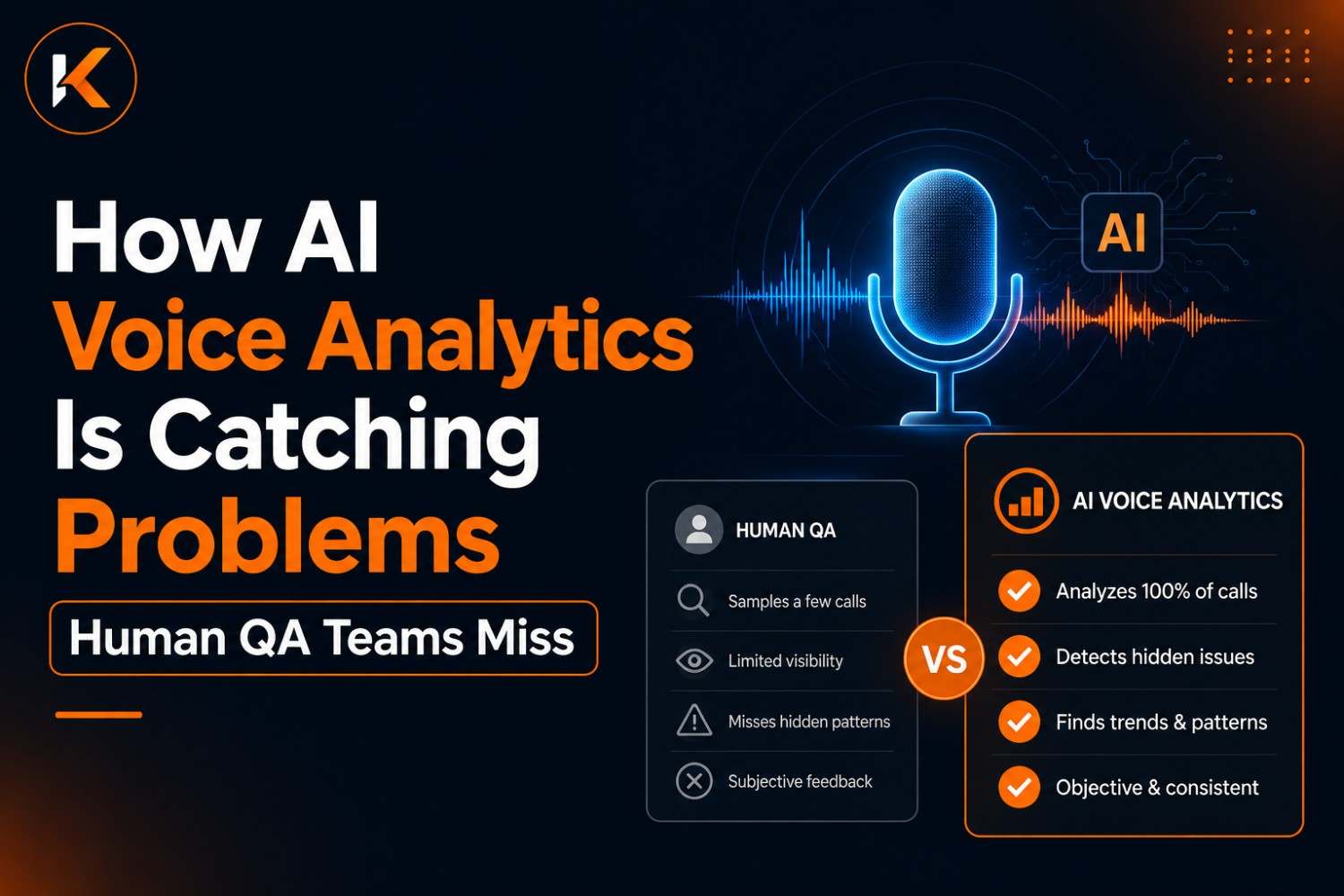
The uncomfortable truth is that human QA teams can only review a tiny sliver of total call volume — typically 2% to 5% of calls, sometimes less. That means 95%+ of every customer interaction happening in your call center is never heard by anyone in a supervisory role. Whatever is going wrong in that unreviewed 95% simply doesn't exist as far as your quality metrics are concerned.
AI voice analytics changes that equation entirely. Instead of sampling, it listens to everything. And what it finds in that gap between "reviewed" and "unreviewed" calls is often the difference between a call center that looks fine on paper and one that's actually protecting revenue, compliance, and customer relationships.
Why Human QA Teams Have a Structural Blind Spot
This isn't a criticism of QA analysts. The limitation is mathematical, not human.
The Sampling Problem
If your call center handles 10,000 calls a week and your QA team reviews 300 of them, you have visibility into 3% of interactions. The other 97% could contain compliance violations, agent burnout signals, competitor mentions, or churn-risk conversations — and no one would ever know, because no one listened.
The Consistency Problem
Two QA analysts scoring the same call can arrive at different conclusions. Fatigue, mood, personal bias, and differing interpretations of a scorecard all introduce variability. A borderline call reviewed on a Monday morning might score differently than the same call reviewed on a Friday afternoon.
The Recency and Volume Bias
QA teams often gravitate toward reviewing calls that are already flagged — long calls, escalations, or calls tied to a complaint. This means the "average" interaction, where subtle problems often live, gets reviewed even less than the overall sampling rate suggests.
The Detection Ceiling
Humans are good at catching what they're trained to listen for — script adherence, tone, opening and closing statements. They are far less consistent at catching things that don't fit a checklist: a slow build of customer frustration across a call, a change in an agent's baseline energy over weeks, or a pattern that only becomes visible across hundreds of calls at once.
What AI Voice Analytics Actually Catches
1. Silent Churn Signals
Customers rarely announce "I'm about to cancel." Instead, churn risk shows up as subtle linguistic and tonal cues — hesitation, flattened enthusiasm, comparison language ("your competitor offers…"), or a shift from active engagement to passive compliance. AI models trained on historical churn outcomes can flag these patterns in real time, even when the call itself sounds "fine" on the surface. A human reviewer sampling 3% of calls will almost never encounter these calls by chance. An AI system listening to all of them catches the pattern every time it appears.
2. Compliance Risk Buried in Long-Tail Calls
Regulatory and compliance issues — improper disclosures, missed required statements, inappropriate promises made to close a sale — don't concentrate in the calls QA teams typically choose to review. They show up randomly, often in otherwise unremarkable calls. AI voice analytics applies the same compliance check to every single interaction, catching violations that would otherwise surface only if a customer complained or a regulator investigated.
3. Agent Burnout Before It Becomes Attrition
Human QA reviews are a snapshot — one call, one moment. AI systems can track an individual agent's tone, pace, pause patterns, and word choice across thousands of calls over weeks or months. A gradual decline in vocal energy, increased dead air, or a rising rate of short, clipped responses can signal burnout long before it shows up in attendance records or resignation letters. This gives managers a genuine early-warning system instead of a post-mortem.
4. Emerging Customer Complaints Before They Trend
When a product bug, billing error, or policy change starts generating complaints, it typically takes days or weeks for that pattern to become visible to leadership through traditional channels — support tickets, escalations, or social media. AI voice analytics can detect a spike in a specific phrase or topic across call volume within hours, giving operations teams a head start on root-causing the issue before it becomes a wider crisis.
5. Script Deviation That Actually Works (or Doesn't)
QA scorecards often penalize agents for going off-script, assuming deviation equals poor performance. But AI analytics can correlate specific deviations with outcomes — showing that certain "unscripted" phrases actually improve resolution rates or customer sentiment. This turns QA from a compliance exercise into a genuine performance-improvement engine, surfacing what top performers do differently rather than just checking whether everyone said the same thing.
6. Cross-Call Patterns Invisible at the Single-Call Level
A single call rarely tells the full story. AI systems can aggregate patterns across thousands of interactions to reveal things no individual review would catch: a specific IVR menu option correlating with higher abandonment, a particular product explanation consistently causing confusion, or a time-of-day pattern in escalation rates. These are structural insights that only emerge at scale.
Where AI Complements — Not Replaces — Human QA
It's worth being direct about the limits here. AI voice analytics is exceptionally good at scale, consistency, and pattern detection. It is not a replacement for human judgment on nuanced, high-stakes calls, coaching conversations, or interpreting cultural and emotional context that models can misread.
The most effective QA operations use AI as a triage and discovery layer — flagging the calls, agents, and patterns that deserve human attention — while human QA analysts focus their limited time on coaching, complex escalations, and the calls the AI flags as highest-risk or highest-opportunity. This shifts QA teams from randomly sampling 3% of calls to deliberately reviewing the most consequential 3%, chosen by data rather than chance.
What to Look for When Evaluating AI Voice Analytics
If you're considering adding AI voice analytics to your call center, a few capabilities separate genuinely useful systems from surface-level "sentiment score" tools:
Full call coverage, not sampling. The core value proposition collapses if the AI system is also only analyzing a subset of calls. Look for 100% call coverage as a baseline requirement.
Trend and cohort analysis, not just single-call scoring. The most valuable insights come from patterns across agents, time periods, and topics — not just a sentiment score on an individual call.
Integration with your CRM and QA workflow. Insights are only useful if they reach the people who can act on them — supervisors, QA leads, and agents themselves — inside the tools they already use.
Explainability. A flagged call should come with the specific transcript moment and reasoning behind the flag, not just a black-box score. This builds trust with QA teams and gives agents actionable, specific feedback rather than vague criticism.
Compliance-specific configurability. Your industry's regulatory requirements should be configurable within the system, not left to a generic sentiment model that wasn't built with your compliance obligations in mind.
Human QA teams aren't failing — they're working within a structural constraint that no amount of effort can overcome. Reviewing 3% of calls will always mean missing 97% of what's actually happening on the floor. AI voice analytics doesn't replace the judgment, empathy, and coaching skill that human QA analysts bring. It removes the sampling constraint entirely, so that judgment gets applied to the calls that matter most — not just the ones a reviewer happened to pick.
The call centers pulling ahead in 2026 aren't the ones with the biggest QA teams. They're the ones that stopped sampling and started listening to everything.
Ready to See What's Hiding in Your Unreviewed Calls?
If your QA team is only hearing 3% of your customer conversations, you're flying blind on the other 97%. AI voice analytics closes that gap — catching compliance risk, churn signals, and coaching opportunities before they cost you a customer or a regulator's attention.
👉 Talk to KrudraCX today and find out what's really happening on every call, not just the ones someone happened to review.
Visit www.krudracx.com and turn 100% call coverage into your competitive advantage.