If you run an outbound call center, there's a metric sitting quietly in your dialer dashboard that can either keep your operation running smoothly — or trigger a class-action lawsuit. That metric is abandonment rate.
Most call center managers know it as "the thing our predictive dialer keeps under 3%." Fewer understand exactly how it's calculated, why regulators care so much about it, or what happens when a campaign quietly drifts past the limit. And in 2026 — with TCPA litigation at record highs — that gap in understanding is an expensive one.
This guide breaks down what abandonment rate actually is, how it's regulated, why it matters far beyond compliance, and what you can do to keep your campaigns both efficient and legally safe.
What Is Abandonment Rate?
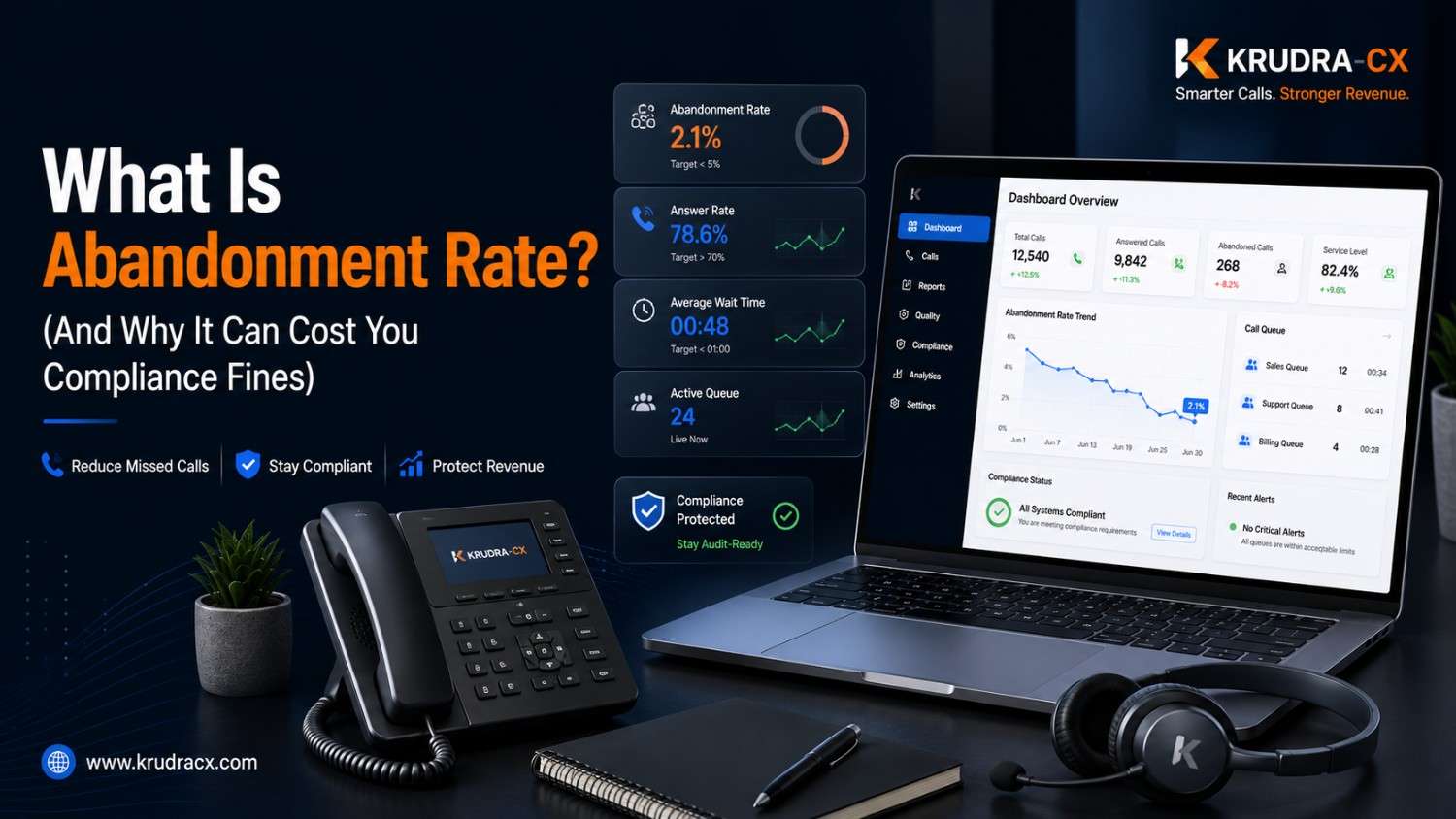
Abandonment rate is the percentage of outbound calls that are answered by a live person but never connected to an agent. The caller picks up, hears silence, a delayed connection, or a recorded message — and no human is there to talk to them.
This typically happens with predictive dialers, which intentionally dial more numbers than there are available agents, betting that a percentage of those calls will go unanswered, hit voicemail, or ring out. When too many calls are answered by real people at once, the dialer can't route all of them to a live agent in time. The excess calls get "abandoned."
The Formula
At its simplest, abandonment rate is calculated as:
Abandonment Rate = (Abandoned Calls ÷ Total Calls Answered by a Live Person) × 100
Note the denominator carefully — it's not total calls dialed, and it's not total calls connected. It's specifically calls that were answered by an actual human. Calls that hit an answering machine, go unanswered, or return a busy signal don't count toward this ratio under federal rules.
Abandonment Rate vs. Connect Rate
These two metrics are often confused, but they measure opposite ends of the same funnel:
- Connect Rate tells you what percentage of your dialed calls reach a live person at all.
- Abandonment Rate tells you what percentage of those live-person answers failed to reach an agent.
A healthy operation wants a high connect rate and a low abandonment rate. You can have a great connect rate and still be in serious regulatory trouble if your abandonment rate creeps up — because the two are independent problems with independent causes.
The Legal Line: Why Regulators Care About Abandonment Rate
Abandonment rate isn't just an internal efficiency number — it's a federally regulated threshold under the U.S. Telephone Consumer Protection Act (TCPA) and the FTC's Telemarketing Sales Rule (TSR), codified at 16 CFR Part 310.
Here's the rule in plain terms: telemarketers using automated or predictive dialing systems are prohibited from abandoning more than 3% of all telemarketing calls answered live by a person, measured over a rolling 30-day period, per calling campaign. On top of that percentage cap, any call that is connected must reach a live agent within 2 seconds of the person answering — meaning agents need to be available and ready roughly 97% of the time a real person picks up.
If a call can't be connected within that window, federal rules require a compliant abandoned-call message: a prerecorded notice identifying the business, along with an automated way for the person to opt out of future calls.
This isn't a soft guideline. It's an enforceable federal standard, and in 2026, state-level "mini-TCPA" laws (like Florida's FTSA and similar statutes in other states) have added their own layers of restriction on top of it — some of them stricter than the federal baseline.
What Actually Counts as "Abandoned"
To stay compliant, it helps to know exactly what does and doesn't count against your 3% cap:
- Counts as abandoned: A live person answers, and no agent connects within 2 seconds.
- Does NOT count: Calls that reach voicemail or an answering machine (assuming accurate answering machine detection).
- Does NOT count: Calls that go unanswered or return a busy signal.
This is exactly why answering machine detection (AMD) accuracy matters so much operationally — a dialer that misjudges a machine answer as a live one (or vice versa) throws off both your reported abandonment rate and your actual compliance exposure.
Why This Can Cost You: The Real Price of Non-Compliance
This is where abandonment rate stops being a "metrics dashboard" issue and becomes a legal and financial one.
Per-Violation Penalties
TCPA violations are penalized per call, per text, or per person contacted — not per campaign. Reported penalty ranges for TCPA violations in 2026 run from roughly $500 to over $50,000 per violation, depending on whether the violation is found to be willful or knowing. For call centers running high-volume predictive dialing campaigns, a single day of an abandonment rate spike can translate into hundreds or thousands of individually actionable violations.
Some legal analyses of predictive dialer exposure put the practical per-call fine range for abandonment-related violations at roughly $500 to $1,500, a number that compounds quickly across a single non-compliant campaign — turning what looks like a minor pacing miscalibration into a six or seven-figure liability.
Litigation Is Accelerating, Not Slowing Down
TCPA isn't a rarely-enforced rule sitting quietly in the federal code. It has become one of the most actively litigated consumer protection statutes in the country:
- TCPA case filings rose sharply between 2023 and 2024, with year-over-year increases reported in the range of 60–70%.
- The overwhelming majority of these filings — commonly cited at around 78% — are brought as class actions, not individual suits.
- Because TCPA allows statutory damages without the plaintiff needing to prove actual financial harm, it's a uniquely attractive target for plaintiffs' attorneys, and campaigns with sloppy abandonment tracking are exactly the kind of low-hanging fruit that draws scrutiny.
State Laws Add Another Layer
Federal TCPA sets the floor, not the ceiling. Several states have passed their own telemarketing statutes that impose additional restrictions and, in some cases, significantly higher per-violation penalties — with some state-level violations reportedly reaching up to $20,000 per violation. If your call center operates across state lines (and most do), you can't assume federal compliance alone keeps you safe.
The Hidden Cost: Carrier Reputation
Fines aren't the only consequence. Carriers now use call pattern analytics — including abandonment behavior — to detect and flag suspicious outbound traffic. A high abandonment rate can look statistically identical to a robocall spam campaign from a network traffic perspective. That means non-compliant dialing doesn't just risk a lawsuit; it risks getting your business's numbers flagged as "Spam Likely" or blocked outright by carriers, quietly killing your connect rates on every campaign — even legitimate ones — going forward.
In short: you can get hit twice. Once by regulators, and once by the phone networks themselves.
Why Abandonment Rate Spikes: Common Root Causes
Abandonment rate rarely blows past 3% because of one dramatic failure — it's usually the result of small operational gaps compounding:
- Overly aggressive dialer pacing. Predictive dialers calculate pacing using statistical models of expected answer rates and agent availability. If those models are miscalibrated — or if real-world answer rates suddenly rise — the dialer keeps placing more calls than agents can handle.
- Unplanned agent shortages. Sick days, shift gaps, or unexpected attrition reduce available agents without a corresponding drop in dial volume, instantly pushing abandonment rates upward.
- Inaccurate answering machine detection (AMD). If your AMD engine misclassifies live answers, your dialer's pacing decisions — and your abandonment math — are built on bad data from the start.
- Sudden shifts in list quality or time-of-day answer patterns. A cleaner list or a well-timed campaign window can produce a spike in live answers that outpaces your staffing plan.
- Lack of real-time monitoring. Many call centers only review abandonment rate at the end of a campaign or reporting period — by which time a multi-day compliance breach has already occurred.
How to Calculate and Monitor Abandonment Rate Correctly
Because the federal standard is measured per campaign, over a rolling 30-day window — not as a single-day snapshot — monitoring needs to be continuous, not periodic.
Best practice for call centers:
- Track daily, not just monthly. Export dialer logs each day and recalculate your running 30-day campaign average, rather than waiting for a monthly report to catch a problem.
- Segment by campaign, not by center. The 3% threshold applies per calling campaign. A blended, center-wide number can mask a single non-compliant campaign hiding inside an otherwise healthy average.
- Cross-check your dialer's reported number against raw call logs periodically. Different dialer platforms sometimes calculate and report abandonment rate slightly differently than how regulators measure it — a gap that can create false confidence.
How to Reduce Abandonment Rate (Without Sacrificing Productivity)
The good news: abandonment rate is one of the most controllable compliance risks in a call center, because it's driven almost entirely by operational settings you own.
1. Tune your dialer's pacing algorithm conservatively. Set predictive dialing ratios with a safety buffer well under the 3% ceiling — not right up against it. Regulators measure over 30 days, so a few aggressive hours can jeopardize an otherwise compliant month.
2. Match dialing mode to campaign risk. Not every campaign needs maximum-throughput predictive dialing. For smaller lists, mobile-heavy contact data, or compliance-sensitive campaigns, progressive or parallel dialing modes — which dial in tighter ratios closer to 1:1 — dramatically reduce abandonment exposure, even if they modestly reduce dial volume.
3. Improve answering machine detection accuracy. Investing in better AMD reduces false-positive live answers, which improves both your real-world abandonment rate and the accuracy of your compliance reporting.
4. Build staffing buffers into forecasting. Real-time workforce management that accounts for unplanned absences helps prevent the agent-shortage spikes that are one of the most common abandonment triggers.
5. Monitor abandonment rate in real time, not retrospectively. Live dashboards that flag when a campaign is trending toward the 3% threshold let supervisors intervene — slowing dialer pacing or pulling in more agents — before a violation accumulates.
6. Keep your 2-second connect message compliant. For the small percentage of calls that are unavoidably abandoned, make sure your automated message correctly identifies your business and includes a working, automated opt-out mechanism, as required under the TSR.
What's Changing in 2026
It's worth noting that the regulatory landscape around abandonment rate isn't frozen in place. In 2026, the FCC opened a Further Notice of Proposed Rulemaking (FNPRM) examining whether the long-standing 3% abandonment cap and 15-second minimum ring time still fit modern outbound calling technology and consumer expectations. This is a request for public comment, not a finalized rule change — meaning the current 3% standard remains fully in effect, and any future adjustment would come through a separate, formal order.
The takeaway for call center leaders: don't wait for regulatory clarity to tighten your compliance posture. If anything, increased regulatory attention on abandonment rate signals more scrutiny ahead, not less.
Abandonment rate sits at the intersection of two things every call center cares about: operational efficiency and legal risk. Push your dialer too hard in pursuit of higher talk time, and you're not just risking a bad customer experience — you're risking per-call statutory penalties, class-action exposure, and carrier-level spam flagging that can quietly damage every future campaign you run.
The call centers that get this right don't treat abandonment rate as a once-a-month compliance checkbox. They treat it as a live operational metric — monitored daily, tuned deliberately, and built into how their dialing technology is configured from day one.
Stop Guessing. Start Protecting Your Campaigns.
Compliance fines are avoidable. Missed revenue from spam-flagged numbers is avoidable. A single miscalibrated pacing setting shouldn't be the reason your call center ends up in a class-action filing.
KrudracX helps call centers monitor abandonment rate in real time, fine-tune dialer pacing safely, and stay inside TCPA and FTC compliance thresholds — without sacrificing agent productivity.
👉 Visit www.krudracx.com today and see how compliant, high-performance dialing actually works.