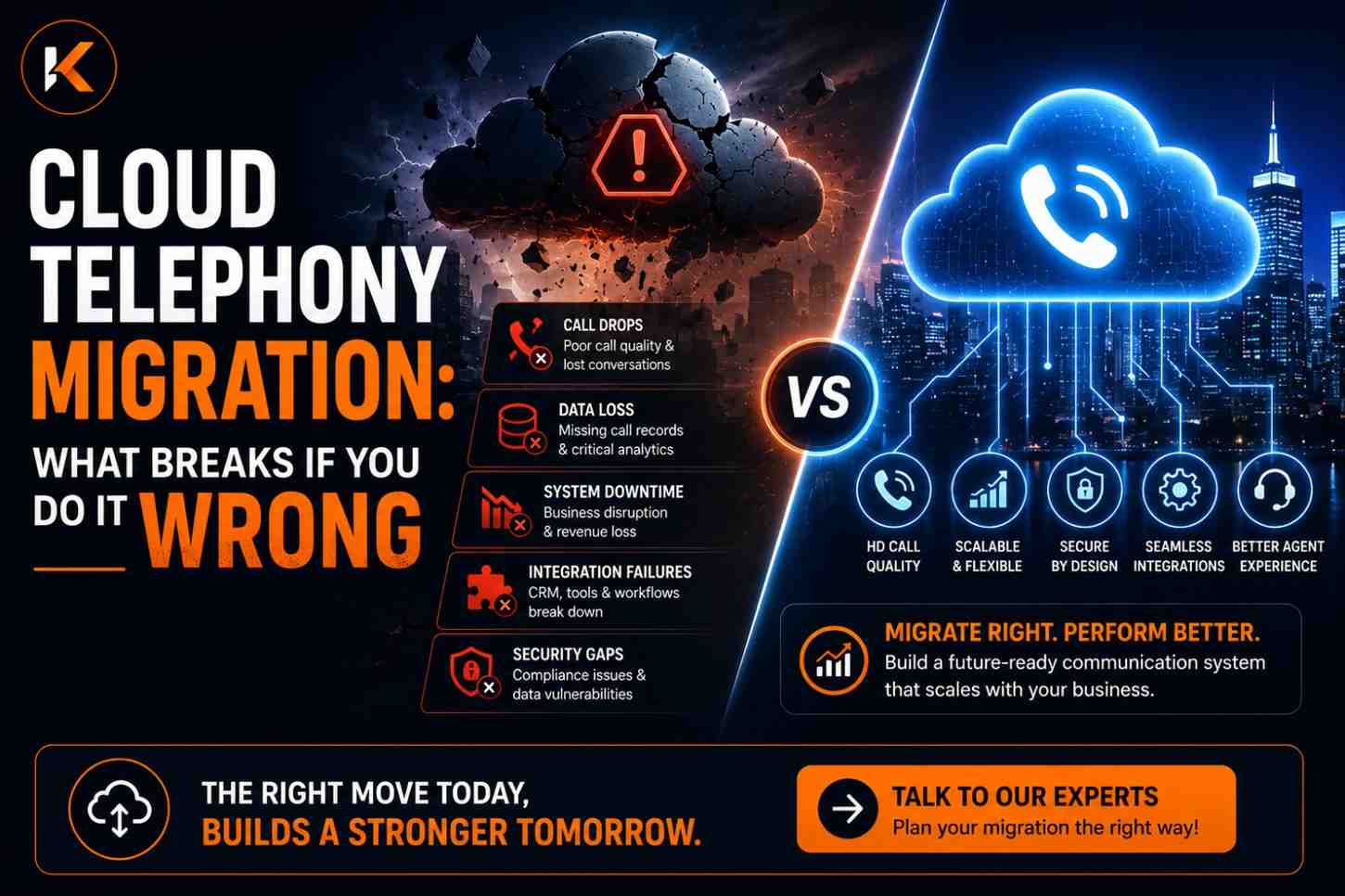
Introduction: The Migration Everyone Underestimates
Cloud telephony migration gets pitched as a simple swap — rip out the old PBX, plug in a cloud-based system, and enjoy lower costs with more flexibility. In reality, it's one of the highest-risk operational changes a call center can make, and it's far more common for something to go wrong than most teams expect going in.
The promise of cloud telephony is real: lower infrastructure costs, remote-work flexibility, easier scaling, and built-in analytics. But the migration process itself is where things quietly fall apart — call quality degrades, historical data gets lost, integrations stop syncing, and customers start noticing before leadership does.
Understanding what actually breaks, and why, is the difference between a migration that pays off within months and one that turns into a multi-quarter firefighting exercise.
Why Cloud Telephony Migrations Go Wrong
1. Bandwidth and Network Readiness Get Assumed, Not Verified
Cloud telephony runs over the internet, which means call quality is only as good as the network carrying it. Many migrations fail not because the cloud platform is flawed, but because the underlying network — bandwidth capacity, latency, jitter, and packet loss — was never properly assessed before go-live. The result: choppy calls, dropped connections, and echo issues that didn't exist on the old on-premise system.
2. Call Routing Logic Doesn't Transfer Cleanly
On-premise systems often accumulate years of custom call routing rules, IVR logic, and escalation paths that were built incrementally and never fully documented. When migrating to a cloud platform, teams frequently rebuild routing from a simplified template rather than mapping the full complexity of the old system — leading to calls landing with the wrong team, skills-based routing breaking, or VIP customer flows getting lost entirely.
3. Historical Call Data and Recordings Get Left Behind
Call recordings, historical CDRs (call detail records), and IVR analytics often live in formats or storage systems that don't migrate automatically to the new cloud platform. Without a deliberate data migration and retention plan, centers can lose access to historical records needed for compliance, dispute resolution, or QA trend analysis — sometimes without realizing it until they need a specific recording months later.
4. CRM and Third-Party Integrations Silently Break
Most call centers rely on integrations between their telephony system and CRM, helpdesk, or workforce management tools — screen pops, click-to-dial, automatic call logging. These integrations are often built for the specific API of the old system. A cloud migration frequently requires rebuilding these integrations from scratch, and if that work isn't scoped properly upfront, agents lose critical context mid-call, and reporting dashboards go dark.
5. Number Porting Delays Cause Real Downtime
Porting existing phone numbers to a new cloud provider is rarely instantaneous. Carrier-side delays, incorrect documentation, or mismatched account details can stall porting by days or weeks. Centers that don't plan a parallel-run period risk a gap where numbers are in limbo — calls failing to connect, going to voicemail, or ringing on a decommissioned system.
6. Agent Training Gets Compressed or Skipped
New cloud platforms often have different interfaces, keyboard shortcuts, and workflows than legacy systems. When training is rushed to meet a go-live deadline, agents fumble through basic functions — transfers, holds, conferencing — during live customer calls, directly impacting handle time and customer experience in the first weeks post-migration.
7. Failover and Redundancy Get Overlooked
On-premise systems often had well-understood backup procedures built over years. Cloud systems need their own failover planning — what happens if internet connectivity drops at a physical location, or if the cloud provider has an outage. Centers that assume "cloud means always available" without building their own redundancy plan are exposed to downtime risk they didn't have before.
The Real-World Impact When Migration Goes Wrong
The consequences of a poorly executed migration extend well beyond IT headaches:
Customer-facing call quality drops, leading to repeat calls, frustration, and lower CSAT scores during the transition window — exactly when the business is trying to prove the new system is an improvement.
Agent productivity dips as unfamiliar interfaces and broken integrations slow down every interaction, inflating AHT and reducing FCR in the weeks immediately following go-live.
Compliance exposure increases if call recording continuity is broken during the cutover, creating gaps in the audit trail for regulated industries.
Trust in future technology initiatives erodes internally — a rocky migration makes it harder to get buy-in for the next necessary upgrade, even if the underlying cloud platform is genuinely better long-term.
How to Migrate Without Breaking Everything
Audit before you migrate, not during. Document every routing rule, IVR path, integration, and reporting dependency in the current system before selecting or configuring the new one. You can't migrate what you haven't mapped.
Test bandwidth and network readiness at every physical location. Run a proper network assessment — not an assumption — covering bandwidth, latency, and QoS configuration, especially for any location relying on shared or public internet connections.
Run a parallel period before full cutover. Keep the old system live in a limited capacity while the new one is tested with real call volume, so number porting issues or routing gaps surface before they affect every customer.
Migrate data deliberately, not as an afterthought. Build a specific plan for historical recordings, CDRs, and compliance data — including where they'll live, how they'll be accessed, and how long they'll be retained — before the old system is decommissioned.
Rebuild integrations with the same rigor as the original build. Treat CRM and helpdesk integrations as a full project scope item, not a checkbox, and test them with real agent workflows before go-live.
Train agents on the new system with real scenarios, not just a walkthrough. Hands-on practice with actual call flows — transfers, holds, escalations — before go-live reduces the productivity dip dramatically in the first weeks.
Build your own redundancy plan. Don't assume the cloud provider's uptime guarantee covers every failure point on your end — plan for local internet outages and have a documented failover process.
Cloud telephony delivers real, well-documented benefits — but only when the migration itself is treated as the high-stakes project it actually is, not a simple swap of one system for another. The centers that migrate successfully are the ones that audit thoroughly, test rigorously, and plan for the messy middle instead of assuming the new platform will just work on day one.
Done right, cloud migration becomes a foundation for better flexibility, lower costs, and richer analytics. Done wrong, it becomes the reason your best customers start noticing something's off — right when you needed them not to.
Ready to Migrate Without the Downtime Drama ?
A cloud telephony migration shouldn't cost you call quality, customer trust, or weeks of firefighting. The right migration partner catches the failure points before they become customer-facing problems.
👉 Talk to KrudraCX today and migrate to cloud telephony the right way — planned, tested, and built to protect your uptime.
Visit www.krudracx.com and make your next system upgrade the one that actually goes smoothly.