If you run a sales team or a contact center, you already know the real problem isn't making calls. It's making calls that actually get answered.
Most outbound teams dial hundreds of numbers a day and get maybe a 8–12% connect rate. The rest is voicemail, disconnected lines, "wrong number," or dead silence. Agents burn hours dialing into a void, and the few conversations they do get are rushed because everyone's trying to hit a call quota, not have a real conversation.
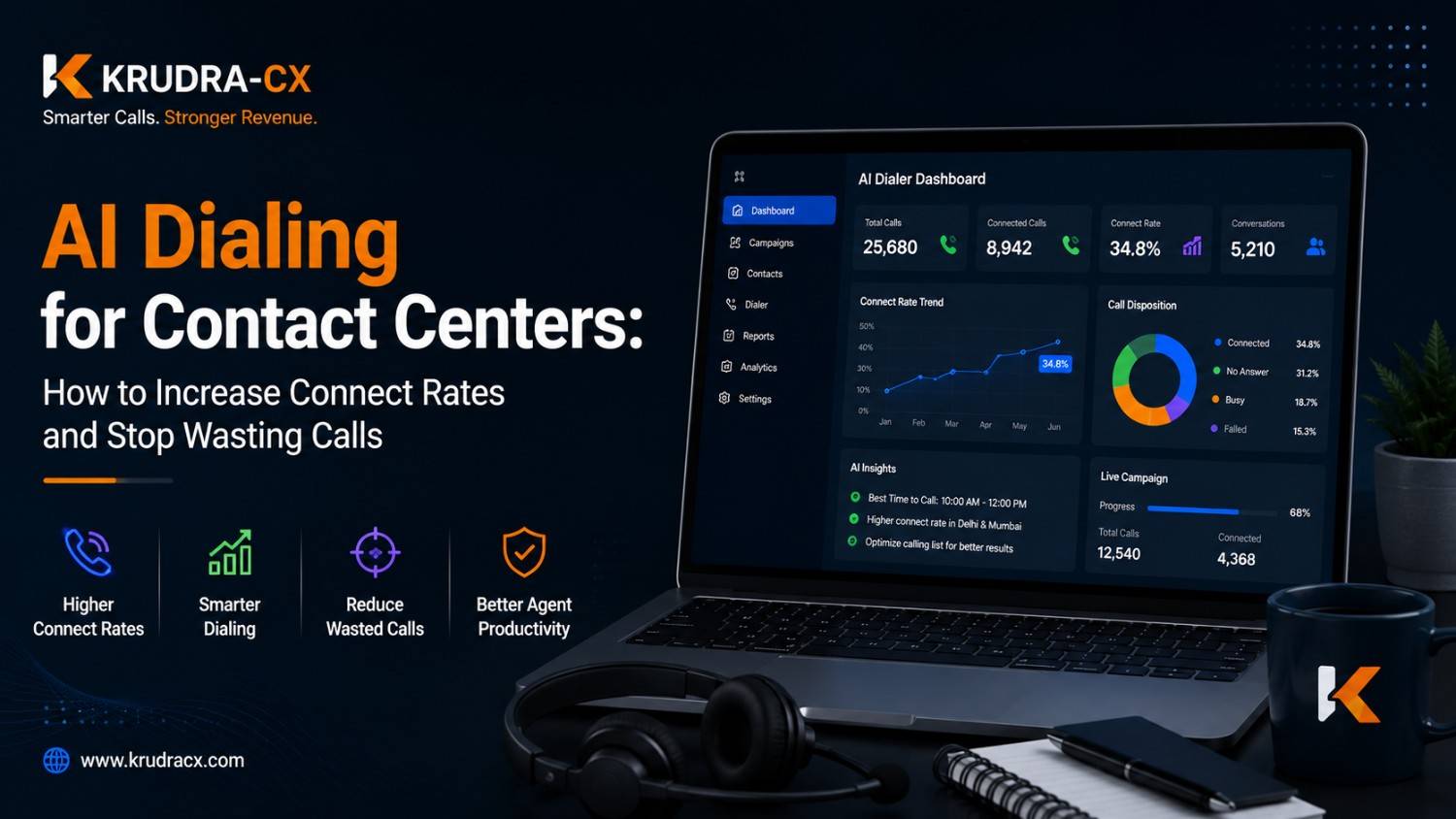
This is where AI dialing changes the math. Not by making agents dial faster — by making sure more of the numbers they dial actually connect to a real, reachable person, at a time that person is likely to pick up.
This article breaks down what AI dialing actually does differently, why traditional dialers plateau, and what to check before you invest in a new system.
Why Traditional Dialing Falls Short
Most legacy dialers — manual, preview, even basic predictive dialers — treat every phone number the same way. They don't know:
- What time zone the lead is in, or when they're actually reachable
- Whether that number has a history of going to voicemail
- Whether the carrier is likely to flag the call as spam
- Which agent is the best match for that specific lead
So the dialer just... dials. In order, or close to it. The result is a connect rate that stays stuck in single or low double digits no matter how many extra lines you add or how hard agents work.
Adding more dialing volume doesn't fix a connect-rate problem. It just means you're wasting more calls, faster.
What AI Dialing Actually Does Differently
AI dialing isn't just "auto dialing with a fancier name." The AI layer sits on top of the dialing engine and makes decisions the old systems couldn't:
1. Best-time-to-call prediction
The system learns from historical answer patterns — by number, area code, industry, even day of week — and prioritizes calls when a lead is statistically most likely to answer, instead of dialing top-to-bottom on a list.
2. Spam/flag risk scoring
Carriers increasingly mark high-volume outbound numbers as "Spam Likely," which tanks answer rates on its own. AI dialing systems monitor number reputation and rotate or rest numbers before they get flagged, instead of burning through a Caller ID until it's dead.
3. Answering machine detection (AMD) that's actually accurate
Older AMD tools misfire constantly — dropping real humans or connecting agents to voicemail. Better AMD models trained on more call data catch the difference faster, so agents spend time on live conversations, not "hello? hello?" dead air.
4. Smart pacing, not just faster pacing
Predictive dialers over-dial to compensate for no-answers, which causes abandoned calls (and compliance risk). AI-based pacing adjusts in real time based on agent availability and current connect probability, keeping abandon rates low without sacrificing dial volume.
5. Lead-agent matching
Some systems route a connected call to the agent most likely to convert that specific lead type, based on past performance data — not just whoever's next in the queue.
None of this replaces a good sales process. It just makes sure your agents are spending their time talking to people, not listening to ring tones.
The Real Impact: What Actually Changes
When contact centers move from a standard dialer to an AI-optimized one, the improvements usually show up in three places:
Connect rate. This is the headline number, and it's usually the biggest jump — teams commonly see meaningful lifts once best-time-to-call and number reputation management are actually working together, instead of dialing blind.
Agent time-to-value. Agents stop spending their shift dialing and start spending it talking. That alone changes morale, because nobody enjoys eight hours of dead air and voicemail.
Cost per conversation. Whether you're paying agents hourly or per call, a higher connect rate means the same headcount produces more real conversations — which is a very different ROI conversation with leadership than "we need more dialers."
None of this is magic. It's the difference between a system that dials numbers and a system that's trying to reach people.
Why Infrastructure Still Matters
There's a temptation to treat "AI dialing" as a plug-and-play SaaS feature you bolt onto whatever you're already running. In practice, the AI layer is only as good as the telephony infrastructure underneath it.
This is where a lot of contact centers get burned — they adopt an AI dialing tool that sits on top of a shaky, overloaded PBX, and the AI's smart decisions get undercut by dropped calls, latency, or a carrier relationship that wasn't built for the volume.
Solid AI dialing needs to be built on infrastructure that can actually handle it:
- Asterisk-based call routing for reliable, flexible telephony that doesn't buckle under concurrent call volume
- GoAutoDial or equivalent campaign management that gives supervisors real control over pacing, lists, and compliance rules — not a black box
- Cloud-based scaling so a busy Monday or a seasonal campaign spike doesn't mean a hardware upgrade project
This is also why "20+ years in IT consulting" isn't just a bio line — a system that's fast when you test it with 5 agents and falls over at 50 agents isn't actually solving your connect-rate problem. It's just moving it downstream.
What to Look for Before You Switch Systems
If you're evaluating an AI dialing provider, a few questions separate the systems that actually move connect rates from the ones that just add a dashboard on top of the same old dialing logic:
- Does it use real answer-rate data, or just call volume data? Ask specifically how the "best time to call" prediction is generated.
- How does it handle number reputation and spam flagging? If they don't have a clear answer, assume they don't handle it.
- What's the AMD accuracy, and can you see it? Ask for real numbers, not a marketing claim.
- Can supervisors control pacing and compliance settings directly? You want visibility, not a black box you have to trust blindly.
- What's the infrastructure underneath? Ask what it's built on — Asterisk, proprietary, or a wrapper around someone else's platform — and how it scales under real campaign loads.
- Can you pilot it on a subset of your list before a full rollout? Any serious provider should be comfortable proving the lift before you commit.
If a vendor can't answer these clearly, you're probably buying a nicer-looking dashboard, not a better connect rate.
The Bottom Line
Connect rate is the single biggest lever most contact centers and sales teams aren't optimizing — because most dialing systems weren't built to optimize it. They were built to dial fast, not dial smart.
AI dialing done right doesn't just add more calls to the pile. It makes sure more of those calls reach a real person who's actually likely to answer, so your agents spend their day having conversations instead of listening to ring tones and voicemail greetings.
That's the difference between a bigger dialer and a better one.
Tired of your team dialing all day for a handful of real conversations?
KrudraCX builds AI dialing systems on proven, scalable infrastructure — Asterisk, GoAutoDial, and cloud architecture — designed specifically to increase connect rates for sales teams and contact centers, not just call volume.
Book a free connect-rate audit and we'll show you exactly where your current system is leaking answered calls — no commitment, no generic sales pitch, just real numbers from your own call data.