The Question Everyone Is Asking — But Few Are Answering Honestly
Walk into any boardroom today and you'll hear some version of the same conversation: "Why are we still paying hundreds of agents when AI can do this for a fraction of the cost?" It's a seductive argument. AI never sleeps, never calls in sick, never asks for a raise, and can handle thousands of conversations simultaneously. On paper, replacing your call center with a chatbot sounds like the smartest cost-cutting move of the decade.
But here's what those boardroom conversations almost always miss: customer experience isn't a cost center. It's a revenue engine. And the businesses that treat it like a spreadsheet problem are quietly hemorrhaging the one thing no AI can manufacture — customer trust.
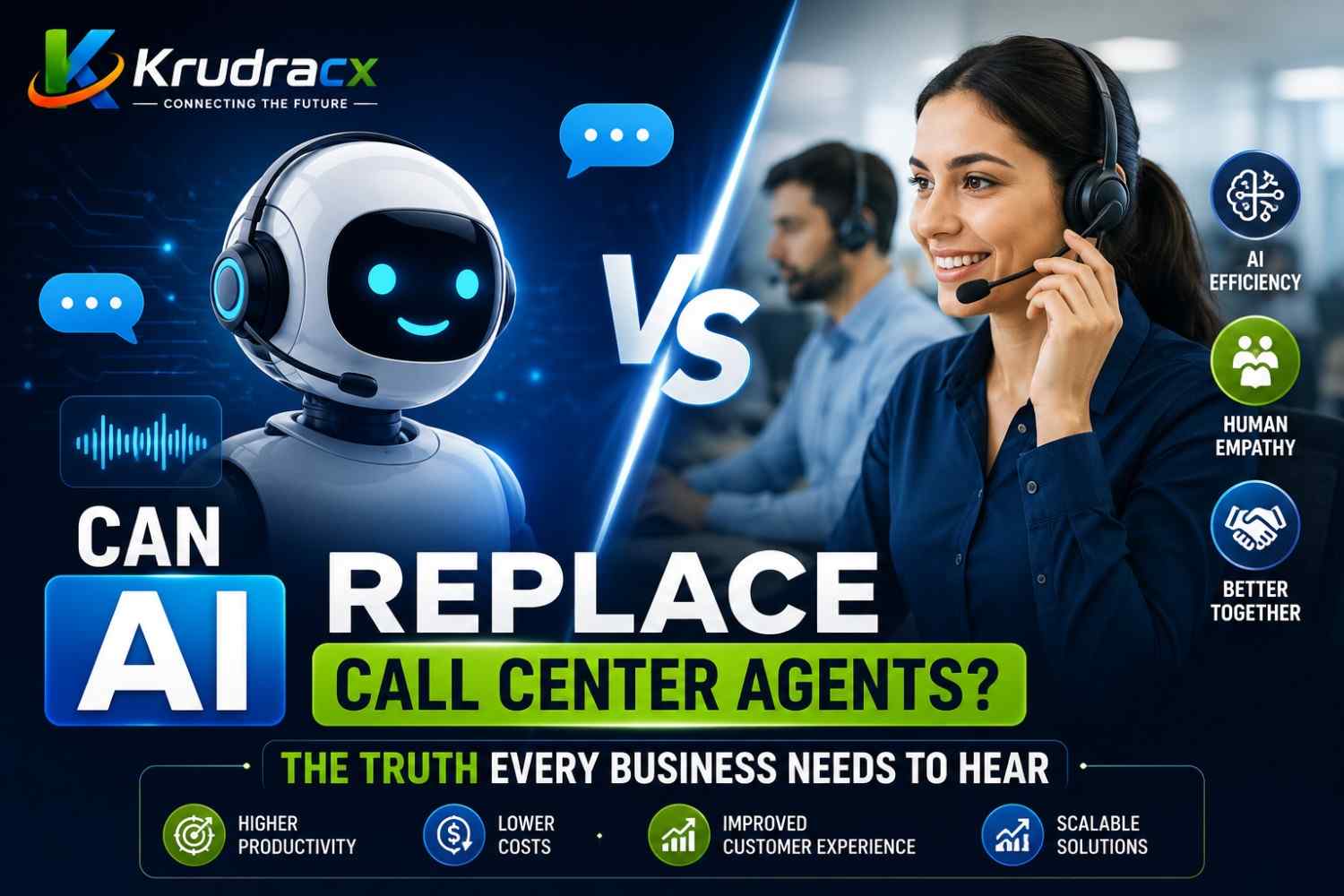
So let's settle this properly. Can AI replace call center agents? The honest answer is: partially, strategically, and only if you know exactly where to draw the line.
Why the "Replace Everything" Impulse Is So Dangerous
The promise of full AI automation in customer support is compelling because the early numbers look great. Deployment costs drop. Response times fall to near-zero. Volume spikes get absorbed effortlessly. Leaders see those metrics and declare victory.
Then the churn reports come in.
According to multiple CX research studies, over 60% of customers say they would switch to a competitor after just one frustrating automated support experience. Not one bad experience with a human. One bad experience with a bot. The tolerance for AI failure in customer service is dramatically lower than for human error, because customers don't extend empathy to machines. When a human agent fumbles, we instinctively make space for it. When a bot fails us — sends us in circles, misreads our frustration, regurgitates a canned response when we need real help — it feels like the brand simply doesn't care.
That perception gap is where companies that rush to full AI automation quietly destroy the loyalty they spent years building.
The problem isn't AI. The problem is misapplication.
What AI Is Genuinely, Brilliantly Good At
Let's be fair to the technology, because it deserves credit where it's earned.
Speed and scale at Tier-1 queries is where AI is essentially unbeatable. If a customer wants to know where their package is, what their account balance looks like, how to reset a password, or what your return policy says — an AI agent will handle that faster, more consistently, and more cheaply than any human team ever could. These are high-volume, low-complexity interactions, and they represent a significant chunk of contact center traffic. Automating them isn't just smart; it's a genuine service improvement. Customers get instant answers at 2 AM on a Sunday without waiting in a queue.
Multilingual support is another area where AI creates value that would be prohibitively expensive to replicate with humans. Deploying AI that communicates fluently across 50 languages doesn't require hiring 50 specialist agents. It requires good training data and the right platform. For global businesses, this is transformative.
Consistency matters more than most companies realize. Human agents have good days and bad days. They interpret policies differently. Their tone shifts based on their mood, their workload, how difficult the previous call was. AI delivers the same answer, the same way, every single time. For compliance-sensitive industries — financial services, healthcare, insurance — that consistency isn't just convenient, it's critical.
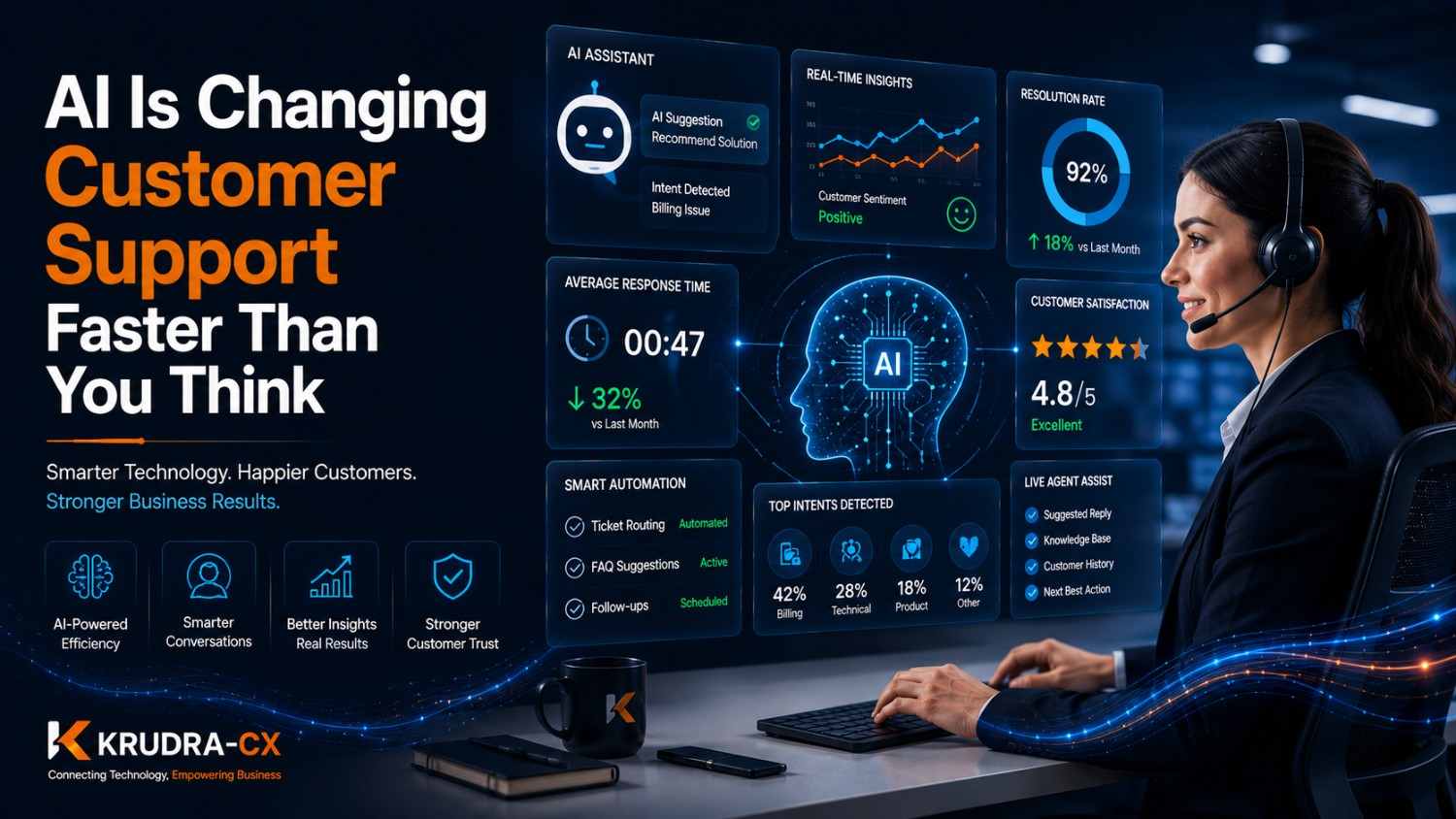
Real-time data synthesis is a capability humans simply cannot match at scale. AI systems process conversation patterns, detect emerging complaint clusters, flag sentiment shifts, and surface insights across millions of interactions simultaneously. A human team reviewing call transcripts manually would take weeks to identify what an AI flags in minutes. That intelligence layer makes AI a genuine strategic asset beyond just answering questions.
So yes — AI is extraordinarily powerful. But power without precision is dangerous. And there is a precise line beyond which AI starts costing you more than it saves.
What Humans Own That AI Cannot Take
Empathy is not a feature you can ship in a software update.
When a customer calls because their flight was cancelled and they're stranded, when someone is disputing a charge after a financial crisis, when a patient is confused and frightened about a medical bill — these aren't support tickets. They're human moments. And the response to a human moment determines whether that person becomes a lifelong customer or an angry review.
Skilled agents don't just solve problems. They regulate emotion, signal that the brand cares, and turn a frustrating experience into a story the customer actually tells positively. That is an art form. It requires reading subtext, adapting tone in real time, knowing when to apologize versus when to advocate for the customer versus when to hold firm. No current AI does this reliably, and the ones that try often make the situation worse by producing responses that feel hollow or tone-deaf at exactly the wrong moment.
Complex, novel problem solving is another domain where humans remain essential. AI excels at pattern matching — recognizing known situations and applying learned responses. But genuine edge cases, situations the system has never seen before, circumstances that require judgment rather than retrieval — these break AI in ways that frustrate customers profoundly. A seasoned human agent improvises. A bot loops.
High-value relationship management — retention calls, VIP client servicing, strategic account support — demands human judgment. These are conversations where the stakes are high, the customer is sophisticated, and the outcome depends on trust built over time. Businesses that automate this layer are essentially telling their most valuable customers that they're not worth a real conversation.
Crisis and reputational moments require humans at the helm. When something goes badly wrong — a product failure, a PR incident, a service outage — the public-facing response cannot be algorithmic. The nuance required, the accountability communicated, the tone calibrated to the severity of the situation — this is where human leadership is non-negotiable.
The Hybrid Model: Where the Real Winners Are Playing
The most successful customer experience organizations in the world have stopped framing this as a binary choice. They're not asking "AI or humans?" They're engineering systems where AI and humans make each other dramatically better.
Here's what that actually looks like in practice.
Tier-1 is AI's domain. Every routine, repeatable, high-volume query gets handled end-to-end by AI. Password resets, order status, account queries, standard FAQs, appointment scheduling — all automated. This frees human agents from the soul-crushing repetition that drives burnout and attrition. It also means customers get instant service for the majority of their needs.
Smart escalation is the critical link. The difference between a hybrid model that works and one that infuriates customers is the quality of the handoff. Good AI systems don't just escalate when they fail to understand a query. They monitor sentiment throughout the conversation. When frustration rises, when language becomes emotionally charged, when the customer asks for a human — the system escalates immediately, seamlessly, with full context passed to the agent so the customer never has to repeat themselves. That last part is crucial. Being transferred and having to re-explain everything from scratch is one of the most reliably rage-inducing experiences in customer service.
Humans are augmented, not replaced. The smartest deployment isn't AI instead of humans — it's AI alongside humans. Agents working with AI assistance are measurably more effective. The AI surfaces relevant customer history, suggests responses, flags policy information, monitors compliance in real time, and tracks sentiment. The human makes the judgment call. This combination consistently outperforms both pure-AI and pure-human approaches on resolution rate, handle time, and customer satisfaction scores.
Continuous learning closes the loop. Every escalation is a training signal. Every complaint pattern spotted by AI is a product insight. The organizations building durable competitive advantage in CX are the ones treating their AI and human systems as a single, learning organism — each side making the other smarter over time.
The Numbers Make the Case
The data on hybrid CX models is increasingly hard to argue with.
Businesses operating hybrid AI-human models report cost reductions of 25–40% compared to fully human operations — substantially less than the "replace everything" pitch promises, but achieved without the customer satisfaction collapse that full automation typically causes.
Customer satisfaction scores in well-designed hybrid environments frequently exceed those of either pure model. Customers appreciate the speed of AI for simple needs and the quality of human support for complex ones. When both are excellent and the transition between them is seamless, the overall experience feels premium rather than budget.
Agent satisfaction also improves. Removing repetitive work from human agents doesn't eliminate jobs — it elevates them. Agents who spend their time on genuinely complex, high-stakes interactions report higher engagement, and their performance on those calls is better because they're not exhausted by a morning of password resets.
The Hard Question for Business Leaders
If you're reading this and running a contact center or making decisions about one, the question you need to ask isn't "how much of this can we automate?"
It's "where in this customer journey does the quality of the human interaction determine whether we keep this customer?"
Map that honestly. The answers will probably surprise you — the line between automatable and human-essential falls in a different place than most leadership teams assume. And once you've drawn it clearly, building a system that honors it on both sides becomes a straightforward engineering problem rather than a philosophical debate.
The companies that win in customer experience over the next decade won't be the ones who eliminated their human teams. They'll be the ones who deployed AI precisely enough to make their human teams exceptional.
Final Word
AI will not replace call center agents. Not completely, not well, not without consequences that outweigh the savings. What AI will do — what it is already doing for the businesses paying attention — is transform the role of human agents from volume-handlers into relationship specialists.
That's not a threat to the workforce. It's an upgrade.
The future of customer experience isn't a choice between a chatbot and a call center. It's a system where neither has to work alone — and where customers feel the difference every single time they reach out.
The businesses building that system right now aren't just cutting costs. They're building something their competitors will spend years trying to catch up to.
Follow @krudracx on Instagram and LinkedIn for more breakdowns on AI, CX strategy, and the future of customer operations.